Houses Explained: Where in Your Life Things Happen
A birth chart sentence has three parts. A planet says what is going on. A sign says how it goes about it. And a house says where in your life it plays out. “Venus in Gemini in the third house” means roughly: affection (Venus), expressed through conversation and curiosity (Gemini), in everyday communication and your close circle (third house).
Houses are the part beginners tend to skip, because they need a birth time. That is a mistake: they are what turns a chart from a personality sketch into a map of a life.
What a house actually is
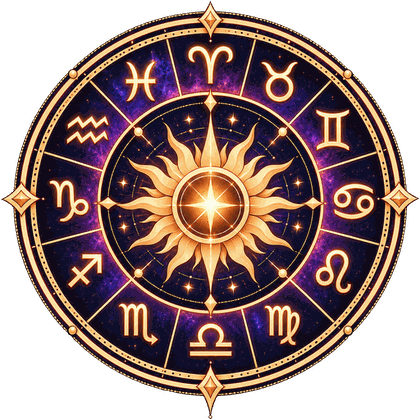
Take the sky as it looked above your birthplace at the moment you were born, and divide it into twelve sections starting from the eastern horizon. Each section is a house. The first begins at the ascendant, the degree of the zodiac that was just rising, and the houses run counterclockwise from there.
Because the Earth turns once a day, the whole arrangement rotates. That is why houses depend on both your birth time and your birthplace, and why two people with the same birthday can have completely different houses.
The twelve, briefly
- First: self, appearance and how you begin things.
- Second: money, possessions and self-worth.
- Third: everyday communication, siblings, short trips and learning.
- Fourth: home, family and your roots.
- Fifth: creativity, romance, play and children.
- Sixth: daily routines, work habits and health habits.
- Seventh: committed partnership and close one-to-one relationships.
- Eighth: shared resources, intimacy and transformation.
- Ninth: travel, higher learning and beliefs.
- Tenth: career, reputation and public life.
- Eleventh: friends, communities and long-term hopes.
- Twelfth: solitude, rest and the subconscious.
Each one has its own page in the Learn section.
Angles, and why some houses are louder
Four points in the chart matter more than the rest: the ascendant (first house), the imum coeli at the bottom (fourth), the descendant (seventh) and the midheaven at the top (tenth). Houses that start on these points are called angular, and planets there tend to be the most visible in a person’s life. The second, fifth, eighth and eleventh follow them and are called succedent; the third, sixth, ninth and twelfth come before them and are called cadent.
More than one way to divide the sky
Astrologers do not all draw houses the same way. Whole sign houses, the oldest method, simply make each sign one house. Placidus, the most common in modern Western astrology, divides the sky by time and produces houses of unequal size. Equal houses divide the zodiac into twelve 30-degree slices from the ascendant. There are others, including Koch and Porphyry.
For most planets the systems agree. They can differ for a planet near a house boundary, and Placidus cannot be calculated at extreme northern and southern latitudes. The Birth Chart Studio uses Placidus and falls back to equal houses near the poles. If a planet sits within a couple of degrees of a line, it is worth reading both houses.
What if a house is empty?
Most charts have several empty houses, and it is not a sign of anything missing. An empty house still has a sign on its edge, and the planet that rules that sign tells you where to look. If the seventh house is empty and Libra is on the edge, for instance, you would look at where Venus, the ruler of Libra, sits.
Using houses without overreading them
Houses describe areas of attention, not guarantees. A planet in the tenth house suggests career matters will be prominent for you, not that you will be famous. A planet in the seventh suggests partnership will be a major theme, not that you will marry young. Use them as prompts for questions about your own life and they will reward the attention.